

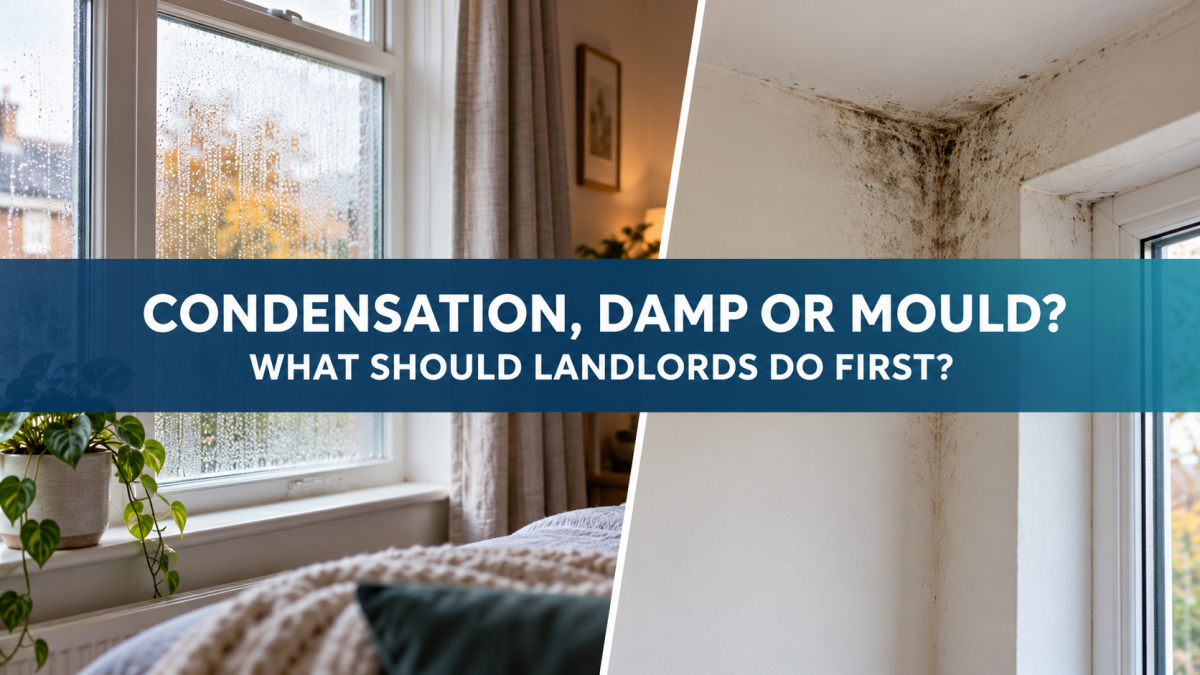
Condensation, Damp or Mould: What Should Landlords Do First?
A tenant sends you a photograph of a black patch around the bedroom window.
What happens next matters.
It might be condensation. It could be water getting in from outside. There may be a leak, a ventilation problem or several issues working together.
What it should not become is a debate over blame before anyone has properly looked at the property.
Damp and mould can affect a tenant’s health and damage the property. The sooner the cause is understood, the sooner the right action can be taken.
Start by taking the report seriously
A report of damp or mould should be acknowledged promptly.
Ask the tenant for enough information to help you understand what is happening, but do not turn the conversation into an interrogation.
Useful questions include:
- Where has the problem appeared?
- When was it first noticed?
- Has it become worse?
- Does it change after heavy rain?
- Is there a leak, dripping pipe or overflowing gutter nearby?
- Is the room difficult to heat?
- Are the extractor fans working?
- Has any furniture or decoration been damaged?
- Does anyone in the property have health concerns that may make the situation more urgent?
Photographs and videos are helpful, but they will not always reveal the cause. In many cases, someone needs to inspect the property.
Damp, condensation and mould are not the same thing
These terms are often used as though they mean the same thing, but they describe different parts of the problem.
Condensation happens when moisture in the air meets a colder surface. It is commonly seen on windows, external walls and in rooms where moisture is produced.
Damp describes unwanted moisture within the property. This can be caused by leaking pipes, damaged roofs, defective guttering, water penetrating through walls, problems at ground level or other building defects.
Mould is a growth that develops where moisture remains present. It is a visible sign that the conditions around it need attention.
The important question is not simply, “How do we clean this off?”
It is, “Why is moisture collecting here in the first place?”
Do not assume it is the tenant’s fault
Cooking, showering, drying washing and even breathing all add moisture to the air. Tenants can help manage this by using extractor fans, keeping vents clear and heating and ventilating the property sensibly.
That does not mean every damp or mould problem is caused by how somebody lives.
A room may be difficult or expensive to heat. An extractor fan may not be working properly. A window may have been fitted without suitable ventilation. There may be a hidden leak, failed sealant or water entering through damaged brickwork.
Telling a tenant to open a window is not a proper response if the underlying problem is a leaking roof.
Give sensible advice where it is relevant, but investigate the condition of the property as well.
Arrange an inspection
An inspection should look beyond the visible patch.
Check:
- External walls, pointing and render
- Roof coverings, flashing and chimney areas
- Gutters, downpipes and drains
- Window frames, seals and trickle vents
- Extractor fans and ventilation
- Heating controls and radiators
- Plumbing around sinks, toilets, showers and baths
- Sealant and grout in wet areas
- Ceilings, corners and chimney breasts
- Areas behind furniture on external walls
- Any previous repairs in the same location
The pattern of the moisture can offer clues, but the cause is not always obvious. Persistent or extensive problems may need to be assessed by a suitably qualified contractor or specialist.
KLA Properties can support landlords with property inspections and ongoing property management across East Sussex.
Deal with the source, not just the surface
Cleaning visible mould may be necessary as an immediate step, but it is not the whole repair.
If the cause is a damaged gutter, leaking pipe, faulty extractor fan or failed seal, that issue must also be dealt with. Otherwise, the mould is likely to return.
The same applies to decorating. Fresh paint may make the room look better for a short time, but it should not be used to hide an unresolved problem.
A proper response may involve:
- Repairing leaks
- Clearing or repairing gutters
- Improving ventilation
- Repairing or replacing an extractor fan
- Renewing damaged sealant
- Addressing defective pointing or render
- Improving heating controls
- Repairing windows or doors
- Removing mould safely
- Allowing affected areas to dry before redecoration
The answer will depend on what the inspection finds.
Keep a clear record
Good records protect the tenant, the landlord and the property.
Record:
- When the problem was reported
- What the tenant described
- Photographs or videos supplied
- When the report was acknowledged
- Any questions asked
- Inspection findings
- Contractors contacted
- Repairs authorised and completed
- Advice given to the tenant
- Follow-up communication
- Whether the problem returned
This is particularly helpful if the cause is complicated or the same area has been affected before.
It also means the landlord is not relying on memory several months later when trying to establish what happened.
Keep the tenant informed
Silence causes unnecessary frustration.
Even if a contractor cannot attend immediately, let the tenant know the report has been received and what will happen next.
If access is needed, arrange it properly. If more than one visit is required, explain why. If a repair depends on dry weather, specialist parts or further investigation, keep the tenant updated.
Good communication does not repair the property, but poor communication can make an already difficult situation much worse.
Check the problem has actually been resolved
A completed contractor visit does not always mean the issue is finished.
Once the repair has had time to work and the affected area has dried, follow up with the tenant. Check whether the damp or mould has returned and arrange another inspection if necessary.
Government guidance on damp and mould in rented homes recommends checking the property at least six weeks after remedial work to make sure the problem has been resolved.
If it has returned, further investigation is needed.
What should landlords do first?
If you receive a report of damp, condensation or mould:
- Acknowledge it promptly.
- Ask for photographs and useful background information.
- Consider whether anyone’s health or safety makes the situation particularly urgent.
- Arrange an inspection.
- Identify the underlying cause.
- Complete the necessary repair or remedial work.
- Keep written records and communicate with the tenant.
- Follow up to check that the problem has not returned.
The biggest mistake is deciding what caused the problem before gathering the evidence.
Early action protects people and property
Damp and mould rarely improve by being left alone.
A small leak can spread. Damaged decoration can become damaged plaster. A minor ventilation problem can become a recurring issue that affects the tenant’s comfort and the condition of the property.
With over 20 years of local property experience, Kirsty and the KLA Properties team understand that good property management means investigating concerns properly, coordinating the right work and keeping everyone informed.
KLA Properties supports landlords across Hailsham, Eastbourne and wider East Sussex with property inspections, maintenance coordination, compliance support and ongoing property management.
Concerned about damp or mould in a rental property? Contact KLA Properties for clear, practical advice.
Office: 01323 405240
Email: info@klaproperties.co.uk
Website: www.klaproperties.co.uk